Most of It Was Wild
A foraged breakfast — the twenty in the bowl, what they are, and the record worth making with her
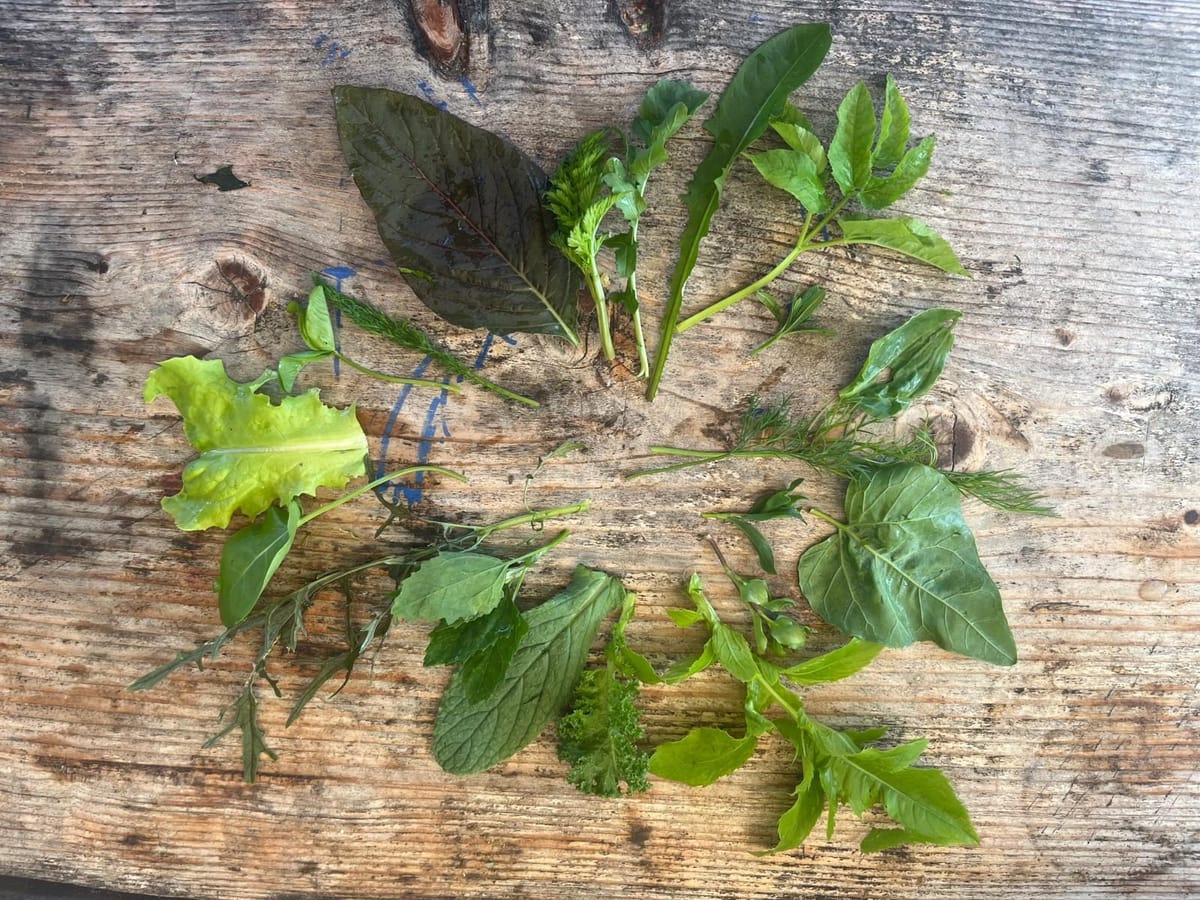
The salad came out with breakfast, after the chores, while the house was still cool.
Most of what was in it had been on the hillside the day before.
Twenty kinds, give or take. A few from the beds. The rest gathered.
The woman who is here this week knows the plants — which ones, where, when, what to take and what to leave standing.
More than forty thousand people follow her channel.
I could have named maybe five of them on my own. She named the rest, and named what each was good for, and I have already lost half of it.
So I wrote them down. This is what was in the bowl:
Achillea millefolium — yarrow,
Aegopodium podagraria — ground elder,
Amaranthus cruentus — red amaranth,
Anethum graveolens — dill,
Anthriscus sylvestris — cow parsley,
Borago officinalis — borage,
Brassica oleracea — kale,
Brassica rapa subsp. nipposinica — mizuna,
Chenopodium album — lamb's quarters,
Cirsium oleraceum — cabbage thistle,
Eruca sativa — arugula,
Foeniculum vulgare — fennel,
Galium aparine — cleavers,
Plantago lanceolata — ribwort plantain,
Plantago major — greater plantain,
Polygonum aviculare — knotgrass,
Rumex acetosa — sorrel,
Spinacia oleracea — spinach,
Stellaria media — chickweed,
Taraxacum — dandelion,
Trifolium pratense — red clover.
A few of those came from the beds. Most came from the hill.
Some of what was in the bowl was food. Some of it was older than food.
The yarrow staunches blood. The country people called it the blood-herb long before anyone wrote down the reason, and the reason turned out to be true.
The plantain — the flat leaf at the edge of every path — is the one you press to a cut. There is a story here about a woman who understood that and told her village, and the village never unlearned it.
The sorrel carries the sour, and the sour is what broke the winter. The first green soup of spring was medicine before it was a recipe — eaten when the cellar was bare and the body had gone too long without anything living in it.
The bitter ones, the dandelion among them, were for the slow waking of a body after the cold.
And one of them fed people through the hunger years, when there was nothing else, and it was dense enough to keep them alive. That one I will not make light of.
None of this is a revival here. It never left, so there was nothing to revive.
In these mountains the turn of June is when the herbs are held to be strongest — taken at full bloom, or on the short midsummer night, when the old belief puts the healing at its height. The young women gather them for the wreaths. The ones who know gather the same plants to dry for the year's medicine.
I arrived in that window without knowing it was a window.
Some of it she shares already — that is what the channel is. But a feed is scattered, out to strangers, in pieces.
What is not written anywhere is the whole of it in one place, in her words — the names, the seasons, the keeping. The part that is only hers, not yet handed to anyone in this valley, still leaves when she does.
There is something worth making out of that. Not a study of her. A record made with her — what she gathers, when, how she keeps it past its short week — hers as much as mine.
The smallest version would be one walk. Her talking, me listening and writing it down. One plant taken properly, from the hill to the drying. If this morning was good, there may be more of it. If not, it was still a good morning.
It was the most refreshing thing I have eaten in days. I think now it was more than the cold of the morning.
She knows what to gather, and how to keep it.
Day 8 — Kompostieren — Soil and Peace
Verkhovyna, Carpathian Mountains, Ukraine
© 2026 Michel Garand | Soil and Peace | CC BY-SA 4.0
stewardship@ubec.network